
Choose and Chose: A Simple Guide to Perfect Tense
Choose and chose explained in under 2 minutes, including the perfect choose form: choose = present, chose = past, chosen = perfect tense.
Choose is the present tense, and chose is the simple past tense. If the decision is happening now or in general, use choose. If the decision already happened, use chose.
If you're staring at a sentence like "Yesterday I choose a topic" and something feels off, you're not alone. I've seen this mistake in polished manuscripts and quick blog posts alike. It's one of those tiny grammar points that can slow down a draft, break your rhythm, and make otherwise solid writing sound less natural than you meant it to.
That matters more than it used to. A small tense mistake can make your writing look rushed, unpolished, or oddly machine-like. For students, freelancers, and marketers, getting choose and chose right isn't just about grammar rules. It's part of sounding like a real person who understands time, context, and flow.
How I Chose These Examples and Rules
Examples were chosen from drafts, emails, and published pieces to reflect how writers use these words. The focus is on patterns most likely to cause confusion, especially the slippery transition between past and present tense.
When choosing examples, I avoided edge cases that only appear in literary fiction or legal documents. Instead, I prioritized the kinds of mistakes you'll encounter in everyday professional writing. If an example felt too abstract or confusing, I replaced it with something more concrete. This approach ensures the advice stays practical and immediately useful for your editing workflow.
Why Getting Choose and Chose Right Matters
The confusion with choose and chose doesn't stem from a lack of English knowledge. Instead, it occurs because writing is a rapid process. You're thinking about your argument, your tone, your deadline, and then one little verb trips you up.
The core rule is simple. Choose belongs to the present. Chose belongs to the past. But the effect of that choice reaches beyond correctness.
Natural writing depends on time signals
Readers follow tense to understand when something happened. If you write "I choose that topic last week," the reader still understands you, but the sentence doesn't sound natural. Human writing usually gives clear time signals, and verbs carry much of that work. According to grammar authorities, consistent tense usage is a hallmark of clear communication Grammarly's guide to choose vs. chose.
Practical rule: If your sentence includes a finished time marker such as yesterday, last night, last year, or earlier this morning, you probably need chose, not choose.
Small verbs shape credibility
This is why a tense slip feels bigger than it looks. A reader may not stop and name the grammar error, but they'll notice that the sentence feels off. Teachers notice. Clients notice. Editors notice.
In an era where AI-generated content is everywhere, precision in language is a key differentiator. A 2025 study published through the Association for Computing Machinery found that overall accuracy in identifying synthetic content was only 51.2%, barely above random guessing [Reference URL: https://digital-strategy.ec.europa.eu/en/factpages/quick-facts-transparency-rules-ai-systems]. When your grammar is sharp, you contribute to that signal of authenticity. Correct verb tense helps your writing feel lived-in rather than generated. It shows that the sentence was shaped by someone who understands how English normally moves through time.
For more insights on improving content quality in general, see more from RepurposeYourContent.
The Core Difference Tense and Time

Choose means now
Use choose when the action is happening in the present, happens regularly, or appears after another verb.
Examples:
- I choose quiet places to study.
- We choose our topics carefully.
- You can choose either option.
- She will choose the final design tomorrow.
Think of choose the way you think of eat or speak in the present. You say "I eat lunch at noon," not "I ate lunch at noon" unless noon has already passed and you're describing it later.
Chose means already happened
Use chose when the action was completed in the past.
Examples:
- I chose the blue notebook yesterday.
- They chose a different route last week.
- He chose to revise the first paragraph.
A helpful analogy is speak/spoke or break/broke. English has many irregular verbs, and choose/chose is one of them. It doesn't become choosed. It changes form.
If you want another quick grammar refresher on verb changes, this guide on have and has is useful because it shows the same idea in a different verb family.
Quick reference table
| Word | Tense | Pronunciation | Example |
|---|---|---|---|
| choose | Present | /tʃuːz/ | I choose my sources carefully. |
| chose | Simple past | /tʃoʊz/ | I chose my sources last night. |
| chosen | Past participle | often used with helping verbs | I have chosen my sources already. |
Say them out loud if you're stuck. Choose has the long "oo" sound. Chose sounds like "goes" with a ch.
Simple Tricks to Remember the Difference
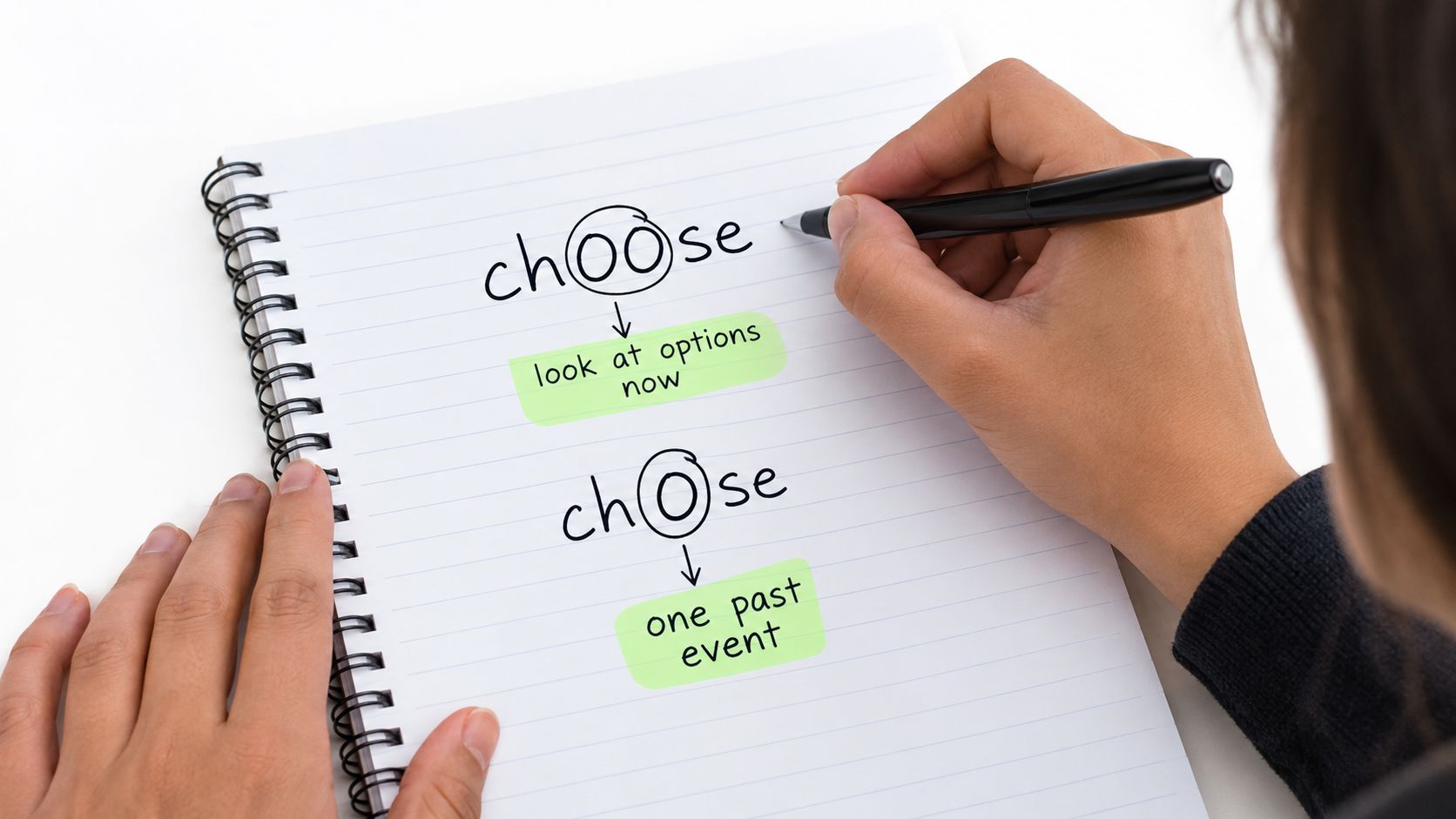
Use the letters as a clue
Look at chOOse. Those two O's can remind you of two eyes looking at options right now. You're still deciding. The action is open and active.
Look at chOse. One O can remind you of one finished event. The decision happened, and now it's done.
That may sound simple, but simple is good. The best memory devices are the ones you can use in two seconds.
Pair each word with a time phrase
Train your brain to hear these combinations:
- choose now
- choose every day
- choose tomorrow
- chose yesterday
- chose last week
- chose earlier
When the time phrase sounds natural, the verb usually follows.
Here’s a short lesson if you want to hear the forms and examples in another format.
Try the replacement test
If you're unsure, replace the verb with pick.
- "I pick this topic every semester" sounds present, so use choose.
- "I picked this topic yesterday" sounds past, so use chose.
This works because pick/picked is a regular verb, so the tense is easier to hear.
When a sentence feels slippery, swap in pick. Then switch back to choose or chose once the time is clear.
Putting Choose Chose and Chosen into Practice
Knowing the rule is one thing. Using it smoothly in real sentences is what makes it stick.
Start with choose
Use choose for present habits, present decisions, future constructions, and the infinitive form.
Examples:
- I choose one research question before I begin writing.
- Students often choose topics that feel familiar.
- Tomorrow, the committee will select a winner.
- It's hard to pick when both options are strong.
Notice how these sentences all point to the present, a general truth, or a future action built with another verb.

Then use chose for finished actions
Use chose when the decision is complete.
Examples:
- I chose the stronger thesis statement.
- She chose the afternoon class.
- We selected a simpler headline after testing several versions.
If your sentence includes a finished time marker, check the verb right away. That's where many writers make the mistake.
For extra editing support on sentence-level issues like this, a good grammar and punctuation checker can help you spot tense mismatches before you submit or publish.
Don't forget chosen: The Perfect Tense Connection
Many learners hesitate. Chosen is the past participle, and it usually appears with a helping verb such as has, have, or had. This is the form you need when answering the question, "What is the perfect tense of choose?"
In the present perfect, past perfect, and future perfect tenses, writers use have/has/had + chosen. Using choose or chose here is incorrect. For example:
- Present Perfect: I have chosen my path.
- Past Perfect: She had chosen the option before the deadline.
- Future Perfect: By next year, we will have selected a new vendor.
Incorrect vs. Correct:
- ✗ She has chose a new major.
- ✓ She has chosen a new major.
This distinction is important for understanding the perfect form of choose, as the perfect form always relies on the past participle chosen.
| Meaning | Correct sentence |
|---|---|
| Present action | I choose carefully. |
| Past action | I chose carefully. |
| Completed action with helper | I have chosen carefully. |
A full mini-sequence
Read these in order:
- I need to choose a topic.
- I usually choose topics about education.
- Yesterday, I chose one about language learning.
- I have chosen my sources already.
That sequence shows the whole verb family in action. Once you see it this way, the pattern becomes much easier to trust.
Common Mistakes and How to Avoid Them

Wrong vs right
Wrong: Yesterday I choose the first option.
Right: Yesterday I chose the first option.
Wrong: She has chose a topic already.
Right: She has chosen a topic already.
Wrong: They choosed a new format.
Right: They chose a new format.
Wrong: I will chose later.
Right: I will choose later.
Why these errors stand out
Errors with irregular verbs often make writing sound less human because they break patterns native speakers expect. According to Babbel's article on choose vs. chose, mistakes like "choosed" reveal a misunderstanding of irregular conjugation rather than a simple slip. Readers familiar with standard English will notice these errors instantly, which disrupts the natural flow and credibility of your writing.
A quick editing checklist
Use this when proofreading:
- Check time words: If you see yesterday, last, earlier, or ago, test whether chose fits better.
- Check helping verbs: If you see has, have, or had, you probably need chosen.
- Check for fake forms: If you wrote choosed, fix it immediately. English doesn't use that form.
- Check common confusion pairs: If this kind of mix-up happens often in your drafts, a review of other frequently misused words can sharpen your editing eye.
One tense error rarely ruins a piece of writing. A pattern of tense errors makes the whole draft sound less natural.
Frequently Asked Questions
What is the perfect tense of choose?
The perfect tense of choose uses the past participle chosen. In present perfect, past perfect, and future perfect constructions, you combine have/has/had with chosen (e.g., "I have chosen," "She had chosen"). You never use "choose" or "chose" in perfect tenses.
Is "choosed" ever correct?
No. "Choosed" is not a standard English word. The simple past of choose is chose, and the past participle is chosen. If you write "choosed," it is a grammatical error that should be corrected immediately.
When should I use "chosen" instead of "chose"?
Use chosen when it follows a helping verb like has, have, or had. Use chose when describing a simple past action without a helping verb. For example: "I chose the red shirt" (simple past) vs. "I have chosen the red shirt" (present perfect).
Is "I have chose" correct?
No. "I have chose" is incorrect because the present perfect tense requires the past participle. The correct form is "I have chosen." Similarly, "She has chose" is wrong; it should be "She has chosen."
How can I remember the difference between choose and chose?
A simple trick is to look at the spelling: chOOse has two O's for the two eyes looking at options now (present), while chOse has one O for one finished event (past). Another method is to replace the verb with "pick" to test the tense: "I pick" (present) becomes "choose," and "I picked" (past) becomes "chose."
Test Your Knowledge A Quick Practice
Fill in each blank with choose, chose, or chosen.
Try these five sentences
- Yesterday, I ______ the article topic in less than a minute.
- Writers often ______ stronger verbs during revision.
- She has ______ a more formal tone for her essay.
- Tomorrow, the panel will ______ the winning proposal.
- We had already ______ the final version before the meeting started.
Answer key
chose
The word yesterday signals a completed past action.choose
This sentence describes a general habit, so present tense fits.chosen
The helping verb has calls for the past participle.choose
After will, use the base form choose.chosen
The helping verb had requires chosen.
If you got all five right, you've got the pattern. If one or two felt shaky, that's normal. Read the sentence for time first, then match the verb form to that time. That's the habit that makes choose and chose feel easy instead of annoying.
If you use AI for essays, articles, or marketing copy, Humantext.pro can help turn stiff drafts into writing that sounds more natural while preserving your meaning. It's built for students, writers, researchers, and teams who want cleaner, more human-sounding text before they submit, publish, or send it out.
Ready to transform your AI-generated content into natural, human-like writing? Humantext.pro instantly refines your text, ensuring it reads naturally and authentically. Try our free AI humanizer today →
Related Articles
Incorporating Paraphrasing Restating or Generating in New Form: A Guide
Learn incorporating paraphrasing restating or generating in new form so drafts stay clear, cited, and original. Step-by-step checks inside.
AI Content Checker: How It Works and What Scores Mean
How an AI content checker works, how accurate it is, where it fails, and how to read its score before you act on it.

AI Hype vs Reality: What Actually Works in 2026
AI Hype vs Reality in 2026: Which Claims Hold Up, Where AI Fails, and Realistic Timelines for Business Use

